
A receding hairline at 30 is common, and the right cut can make it far less noticeable. Short, textured styles work well, while long hair combed forward tends to draw the eye to the very thing it hides. If the hairline keeps moving back despite good styling, it is worth seeing a hair transplant surgeon.
Below are the cuts that work with tailoring and smart-casual looks, plus the ones to drop. It also covers how to tell if your hairline is still moving and when a consultation makes sense.
Which haircuts work best with a receding hairline?
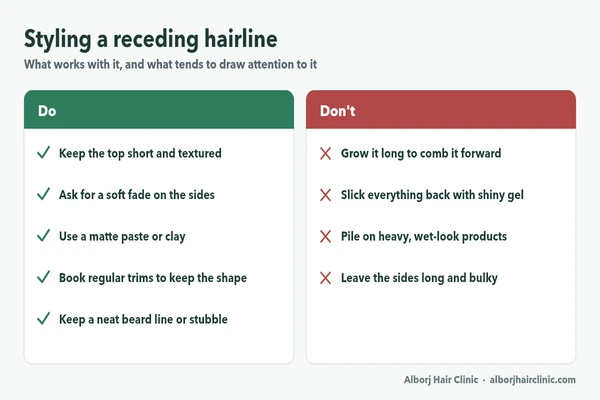
The aim is to reduce contrast. When the hair on top is much longer than the hair at the temples, the eye goes straight to the gap. Shorter, textured cuts even this out.
- Textured crop. Short on top with a choppy, slightly forward fringe. It softens the temples without trying to cover them.
- French crop. A short, straight-cut fringe that sits low on the forehead. It looks neat above a shirt collar and tie.
- Buzz cut. One even length all over makes the hairline much less of a focal point, and it pairs cleanly with tailoring.
- Tight sides with a soft fade. Keeping the sides short makes the top look fuller by comparison.
Ask your barber to keep some texture on top rather than a blunt, heavy finish. Texture breaks up the line and makes hair look denser.
Which styles should you avoid?
Anything that relies on length to cover the temples tends to backfire. Long hair combed forward separates as the day goes on, and gaps show in wind, humidity or under bright office lights.
- The comb-forward. It reads as a cover-up, and it rarely survives a humid Dubai afternoon.
- Slicked-back styles. Pulling everything back with shiny gel puts the temples on full display.
- Heavy, wet-look products. They make strands clump together and show more scalp. A matte paste or clay gives a fuller finish.
- Long, bulky sides. They make the top look thinner by contrast.
Grooming beyond the hair helps too. A neat beard line or well-kept stubble adds structure lower down the face, and well-cut tailoring draws attention away from the forehead.
How can you tell if your hairline is still receding?
Not every change at 30 is hair loss. Many men’s hairlines rise slightly between their late teens and late twenties as the boyish hairline matures. This shift is usually even, and it tends to stop.
Pattern hair loss looks different. It usually deepens at the temples first, forming an M shape, and may be joined by thinning at the crown. Doctors grade it on the Norwood scale, which runs from a barely changed hairline to extensive loss across the top.
Signs that it may still be progressing:
- The temples are clearly deeper than they were a year or two ago.
- Your barber mentions thinning at the crown.
- Hair on top looks finer, and the scalp shows through under bright light.
- Styles that used to cover the change no longer do.
A simple habit is to check your temples in the same mirror and light every few months. Slow, steady change is easier to spot that way.
When should you see a hair transplant surgeon?
A consultation makes sense when the hairline is clearly moving or styling no longer hides it. It also helps if you simply want to know where you stand. It is an assessment, not a commitment.
The surgeon will place you on the Norwood scale and look closely at the donor area at the back and sides of the head. Hair there usually resists thinning, and its density sets how much can be moved.
Age shapes the plan. At 30, hair loss may still be progressing, so the new hairline needs to work for the long term. Depending on your stage, a doctor may suggest other options first.
“Men in their thirties often ask for the hairline they had at twenty. I prefer to design one that will still look natural at fifty, because the hair around a transplant can keep thinning with age.”
What does a hair transplant involve if you go ahead?
With the DHI (Direct Hair Implantation) technique, follicles are taken out one by one with fine FUE punches. Each one is then placed straight into the receding area with an implanter pen, by hand.
It is done under local anaesthesia, and no stitches are needed. Most men report mild discomfort, with little or no pain.
The result builds gradually. In the first few weeks, the transplanted hairs often shed, which is a normal stage. Fresh growth tends to appear at around three months, with the full result at around 12 months.
If you have a busy diary, plan around the early weeks. Many clinics advise a few days away from the office and a short break from the gym, but follow your own surgeon’s instructions. Once the hair has grown in, any of the cuts above are back on the table.
About Alborj Hair Clinic
Alborj Hair Clinic is a hair transplant clinic in Mazaya Centre, Al Wasl, Dubai. Its surgeon, Dr Dimitrios Ziakas, has 24 years of experience and has performed more than 4,000 hair transplant procedures. He is a member of the International Society of Hair Restoration Surgery (ISHRS) and uses the DHI (Direct Hair Implantation) technique.
Before-and-after case studies on the clinic’s website give a realistic sense of how hairline results look once the new hair has grown.
Frequently asked questions
Is a receding hairline at 30 normal?
It is common. Pattern hair loss often begins in the twenties or thirties, although the pace varies a lot from one man to the next.
Can a haircut really hide a receding hairline?
It can make it much less noticeable, especially in the early Norwood stages. Short, textured cuts usually work better than long styles that try to cover the temples.
Is 30 too young for a hair transplant?
Not necessarily. The surgeon looks at your stage of hair loss, your donor hair and how your hairline may change. The plan should give a result that still suits you later.
Will a transplant stop the rest of my hair from thinning?
No. Transplanted follicles normally keep growing for life, but the original hair around them can still thin. That is why the surgeon plans for the future from the start.